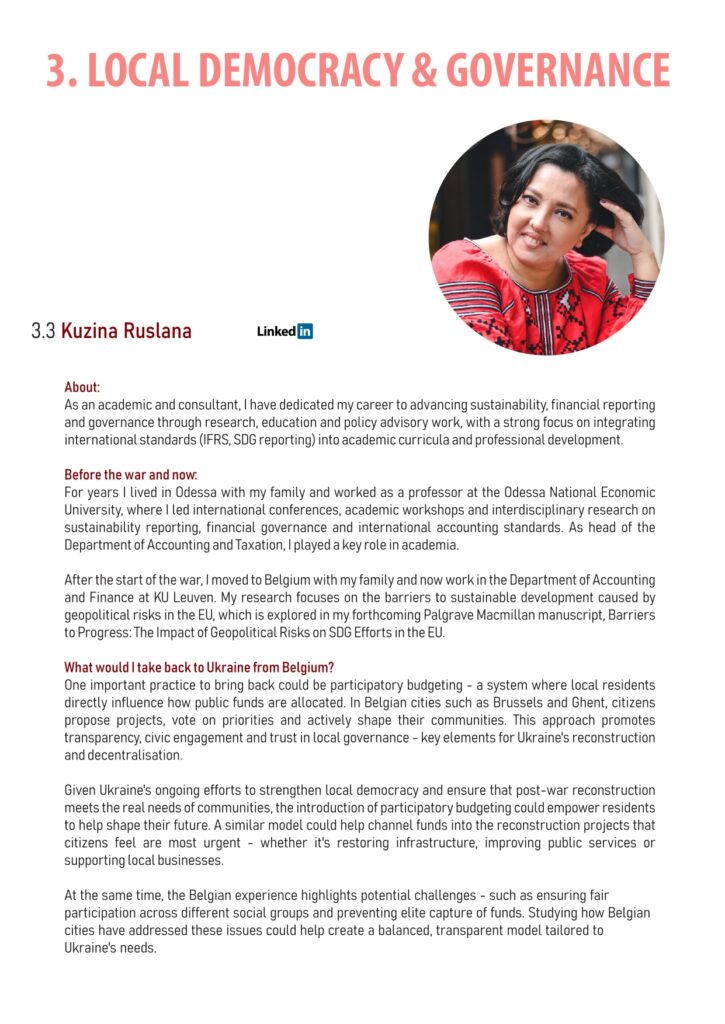
Today Ruslana Kuzina speaks.
About:
As an academic and consultant, I have dedicated my career to advancing sustainability, financial reporting and governance through research, education and policy advisory work, with a strong focus on integrating international standards (IFRS, SDG reporting) into academic curricula and professional development.
Before the war and now:
For years I lived in Odessa with my family and worked as a professor at the Odessa National Economic University, where I led international conferences, academic workshops and interdisciplinary research on sustainability reporting, financial governance and international accounting standards. As head of the Department of Accounting and Taxation, I played a key role in academia.
After the start of the war, I moved to Belgium with my family and now work in the Department of Accounting and Finance at KU Leuven. My research focuses on the barriers to sustainable development caused by geopolitical risks in the EU, which is explored in my forthcoming Palgrave Macmillan manuscript, Barriers to Progress: The Impact of Geopolitical Risks on SDG Efforts in the EU.
What would I take back to Ukraine from Belgium?
One important practice to bring back could be participatory budgeting – a system where local residents directly influence how public funds are allocated. In Belgian cities such as Brussels and Ghent, citizens propose projects, vote on priorities and actively shape their communities. This approach promotes transparency, civic engagement and trust in local governance – key elements for Ukraine’s reconstruction and decentralisation.
Given Ukraine’s ongoing efforts to strengthen local democracy and ensure that post-war reconstruction meets the real needs of communities, the introduction of participatory budgeting could empower residents to help shape their future. A similar model could help channel funds into the reconstruction projects that citizens feel are most urgent – whether it’s restoring infrastructure, improving public services or supporting local businesses.
At the same time, the Belgian experience highlights potential challenges – such as ensuring fair participation across different social groups and preventing elite capture of funds. Studying how Belgian cities have addressed these issues could help create a balanced, transparent model tailored to Ukraine’s needs.
Dear Ruslana, many thanks for your time and attention!